


The small village of Wampum in Lawrence County, Pennsylvania, has long been synonymous with the cement industry. The start can be traced back to the early 1870’s when civil engineer John K. Shinn (1837-1920) took an interest in the local limestone industry. Shinn, a native of Burlington County, New Jersey, had previously been involved with railroad and mining pursuits in Pittsburgh.
A notice in the Pittsburgh (PA) Commercial of Friday, May 23, 1873, reported, “The late firms of GREEN, MARQUIS & CO., at New Castle, and JOHNSON & CO., at Wampum and Pittsburgh, have been this day dissolved by mutual consent, JOHN K. SHINN retiring, and taking the works of JOHNSON & CO., at Wampum.” In this business deal, dated April 1, 1873, John Shinn acquired some of the limestone mine property owned by industrialist George W. Johnson in the vicinity of Wampum. Shinn, a member of the First Presbyterian Church in New Castle, was a talented vocalist became known for singing with veterans’ groups and church events.
Sometime in 1874, John Shinn, with the help of his brothers William P. Shinn (1834-1892) and Joseph A. Shinn (1845-1919), opened a dry-process cement manufacturing plant along the west bank of the Beaver River just south of Wampum in Big Beaver Township. Lawrence County was rich in high-quality limestone and other valuable raw materials such as shale and coal, and this made it a natural location to erect a massive cement plant. The firm was called the Wampum Cement & Lime Company and often referred to as the Shinn Brothers Cement Company. It sold crushed (dry) cement mix, originally sold in wooden barrels (and later in bags), that was used in the manufacture of construction materials such as concrete, mortar, and stucco. Within a few years, the plant was served by several track sidings off the Pennsylvania Railroad (PRR) route between Pittsburgh and Lawrence Junction near Mahoningtown.
Limestone, a key ingredient in the process to manufacture Portland cement, was mined from the hillside just to the west of the plant. Huge blocks of limestone were carted by men and mules to an aerial “rope railroad,” which used gravity to transport the limestone blocks downhill to the crusher at the plant. The mules were later replaced with narrow-gauge “dinky” railroad cars and steam-powered shovels were also put in operation to help unearth the limestone.
The Shinn Brothers plant became one of the first American companies to produce Portland cement, which had previously been imported from Europe since its invention in England in 1824. There is conflicting information regarding which company in the United States was the first to manufacture and market Portland cement. David O. Saylor (1827-1884), with associates Esias Rehrig and Adam Woolever, established a cement plant in Coplay in Lehigh County, Pennsylvania. The Coplay Cement Company started experimenting with techniques to produce Portland cement in the early 1870’s, but when they started production is unknown. The Lehigh Valley region of Pennsylvania went on to become a major player in the cement and steel industries.
Portland cement, named after the limestone on the Isle of Portland in England, is stronger and more durable than regular cement. It’s a type of hydraulic cement, and slowly “cures” over time when mixed with water. Many other types of hydraulic cement cure quickly and even underwater but are not as strong as Portland cement. Portland cement requires certain raw materials, including a supply of clay and especially high-quality limestone. The ingredients are heated in a kiln (with coal) to produce granules known as clinker, cooled and ground into a fine powder, then mixed with gypsum and other crushed aggregates to produce dried cement.
The New Castle (PA) News of Monday, December 2, 1889, mentioned why Lawrence County was a good choice for a cement plant. The article reported, “The ferriferous limestone stratum which has recently been attracting the attention of capitalists to New Castle and the upper Beaver valley, extends over three-fourths of Lawrence county, at varying depths from the surface, with an average thickness of 16 feet. Chemical analysis has revealed the fact that for various manufacturing purposes this stone is superior to any known.”
Both Saylor and the Shinn Brothers were invited to display their new Portland cement products at the Centennial International Exposition of 1876, a six-month celebration held in Philadelphia that showcased American industrial achievements as well cultures from around the world. It was the first World’s Fair event held in the United States and commemorated the 100th anniversary of the Declaration of Independence. Saylor and the Shinn Brothers’ Portland cement entries were both awarded the prestigious Centennial medal, and this brought acclaim for both companies. The Wampum facility re-marketed its main product as Centennial Portland Cement to take full advantage of the honor and quickly gained a reputation for its high-quality product.
The Wampum Cement firm continued to grow and employed about 50-60 men in the early 1880’s, although business came and went with periods of downtime. The New Castle (PA) Index of Wednesday, November 17, 1880, “The Cement works at Wampum shut down for want of orders. Every other industry in that thriving village is running to its full capacity.” Over the years the plant was usually closed in the winter months due to a lack of orders. The harsh winter weather conditions also made working in the quarries difficult.
The plant came under new ownership in early 1887 and the name was changed to the National Cement Company. The New Castle (PA) News of Wednesday, February 2, 1887, briefly mentioned, “The Wampum Cement Works have been sold to Philip Fisher and William O. Kirkland.” Fisher (1845-1897) and Kirkland (1846-1902) operated the Kirkland, Fisher & Company, which manufactured merchant lime in Wampum, and were well-known area contractors and businessmen. They built the Opera House (IOOF Hall) in Wampum, which was dedicated in March 1894.
Business continued to grow until the financial panic of 1893, which signaled the end of the Gilded Age – a prosperous period of economic growth beginning in the late 1870’s. The New Castle (PA) News of Wednesday, August 9, 1893, reported, “The financial stringency has forced the Wampum Cement works to close. The stone quarries around Wampum are also suspending operations until orders and money are more abundant. A large number of men are thrown out of employment by the closing.” By the turn of the century, the cement plant in Wampum was back on track. Improvements were periodically made to the plant, and an influx of European immigrants – notably Austrians and Italians – supplied an ample supply of employees for the quarry.
The New Castle (PA) News of Wednesday, June 5, 1901, reported, “The National Cement company of Wampum has been re-organized, and changed to an incorporated company under the name of Crescent Portland Cement company. The capital stock is $100,000. The mills are being enlarged so that they will have an output of at least 400 barrels a day.” Bridgewater-based William O. Kirkland (1846-1902), a Girard native who grew up in Wampum, was elected as company president. The other officers were Vice President William J. Prentice, Treasurer George W. Hackett, and Secretary Charles M. Hughes. Richard H. Hughes (1862-1919), the brother of Charles Hughes, was appointed superintendent and oversaw the daily operations in Wampum. Sadly, Kirkland passed away in March 1902 and was succeeded as president by Prentice.
In January 1902, it was announced that a new business, which would utilize local cement, would be established in the village of Wampum. The New Castle (PA) News of Wednesday, January 22, 1902, announced, “The industry is a tile works that manufactures patent roofing and tiling for building purposes, and the works will employ between 100 and 200 men, and no place is better suited for a works of this kind than Wampum. There is a large tile works in Pittsburgh and they are compelled to import the cement used from Germany, but the plan is it use the fine cement for which Wampum is noted and this is the main reason the plant is being located here… It is hoped that the energetic citizens will be rewarded for their efforts by having this public works located in Wampum and make it a pocket edition of New Castle.” (AUTHOR’S NOTE: This plant on Clyde Street was part of the successful American Cement Tile Manufacturing Company, which erected similar plants in Indiana, New Jersey, and Alabama. This facility has gone through many ownership changes, but is still in service in 2026 as the Vesuvius Penn Corp.)
The Crescent Portland Cement Company would soon have local competitors. In 1905, a group of local investors established a cement plant in New Castle with a large quarry in Hickory Township. The New Castle Portland Cement Company was soon sold to a group of Allentown investors and renamed as the New Castle Works of the Lehigh Portland Cement Company. Years later, in 1920, another cement firm opened in Lawrence County when the Bessemer Limestone & Cement Company started production in Bessemer along the Ohio border.
In 1906, the cement company decided to undertake a major expansion and commenced by purchasing additional limestone property. The New Castle (PA) Herald of Tuesday, January 15, 1907, reported, “The first steps towards the construction of the million-dollar cement plant by Crescent Portland Cement company of Wampum, was taken today when an option was taken on the plant of the Wampum Limestone company. One thousand dollars was paid for the option and it is understood that this company will be taken over by the Crescent in a very few days. Thirty-five thousand dollars is the amount it is said will be paid for the plant. The Wampum Limestone company has valuable holdings near this town and possess hundreds of acres of land underlaid with limestone.”
There had been a delay as the New Castle (PA) News of Friday, October 25, 1907, mentioned, “Work of construction has been delayed owing to a complete change of plans with regard to the kind of power to be used. It was the intention when the new plant was first projected to use steam power. Later it was decided to run the plant by electricity… Its completion will mean the biggest boom for Wampum that it has seen since the good ole furnace days. As stated, it is expected that the new plant will employ about 1,000 men. They will likely all live in Wampum or Chewton, just across the river. It will mean a building boom for Wampum such as the place has never before experienced.”
Meanwhile, the old plant remained in operation, but business slowed and operations were closed for about four months in the winter of 1907-1908. The New Castle (PA) Herald of Friday, March 20, 1908, reported, “The Crescent Portland cement company started their upper mill and rolleries this morning. Owing to the fact that there are few orders on hand only a few of the old employes went back to work but it is expected that conditions will improve within a short time.”
The New Castle (PA) Herald of Friday, March 27, 1908, announced, “Contracts for the erection of the new $800,000 Crescent Portland Cement plant at Wampum will be let April 1st. Construction to be commenced at once… The plant was to have been erected last fall but owing to the financial slump it was deferred… Surveyors have already started work of laying out the grounds. The (Curtin-Ruggles) Co., of New York City has charge of the work. R. H. Hughes of Pittsburg, president of the company, is on the ground superintending the work… The cement company owns about 400 acres of land just south of Wampum and it is on a portion of this land that the new plant will be erected.”
Two months later the contract for the $850,000 plant was awarded to National Building & Construction Company of Ellwood City. It was expected the output of the plant would increase from the current 300 barrels a day to 3,000. Six large buildings would be erected on concrete foundations with cement tile roofs. The New Castle (PA) Herald of Monday, June 29, 1908, reported, “The work of constructing the new buildings for the Crescent Portland Cement company in Wampum, is progressing nicely and it is expected that if no delays will be caused, the new plant will be ready for operation the first of the winter… For a time workmen were hindered by copperhead snakes, which abounded in large numbers, but they were about all killed off. The snakes were driven from their holes and dens by the blasting of limestone in the vicinity of the new plant.”
The plant organized its own baseball team as the New Castle (PA) Herald of Saturday, June 27, 1908, mentioned, “Wampum, Ellwood City’s sister city, is baseball crazy. Next Tuesday evening a big social and dance will be held, the proceeds to go for the benefit of the baseball team. It is not the Wampum Independents any more but the C.P.C.’s, the Crescent Portland Cement team. Mr. Hughes, superintendent of the Portland works has announced that his company will purchase new uniforms for the team… the first game of the season will be played Fourth of July when the Belmonts of Youngstown are tackled in a double header… Later on in the season a series of games will be played between the Ellwood City Forge team and the cement team.” The Crescent Portland team (later known as the Wampum Medusas) played baseball, softball, and basketball in county and city leagues for over fifty years. They played opponents from around the region to include Wampum, Ellwood City, New Castle, New Galilee, West Pittsburg, Harlansburg, Bessemer, Hillsville, and New Wilmington.
A lack of adequate housing at Wampum became a major issue. The New Castle (PA) Herald of Friday, January 8, 1909, reported, “Officials of the Crescent Portland Cement company of Wampum yesterday announced that their new plant, which is now under course of construction, would be completed by May 1st… The one question that is disturbing the minds of citizens of the neighboring town is: Where will the workmen live. At the present time there are no empty houses in this town (Ellwood City) or in Wampum and it will be necessary to erect a large number of new houses before men can come here and work. It is predicted that a big real estate boom will occur here in the coming spring.”
Over the years the plant supplied cement for many large-scale projects to include state highways, city streets and sidewalks, bridges and dams, and factories and sports stadiums. The New Castle (PA) Herald of Tuesday, March 9, 1909, reported, “The Portland Cement Company of this town has just been awarded the contract for supplying cement for the new ballpark (Forbes Field) to be built in Pittsburg. As thousands of barrels will be used in erecting the giant stands, it can be seen that the order is a very large one.”
The New Castle (PA) News of Monday, January 3, 1910, mentioned, “Lawrence county is one of the acknowledged cement centers of the country and the people here too often fail to consider this product in listing the industries of this commodity. It is true that the cement plants do not employ as many high salaried employes as the steel and tin mills and the various plants in the city, but they help and they turn the limestone into money that comes back here, and they send New Castle cement to the four corners of the earth in the very great benefit of New Castle in an advertising way.”
An article in the New Castle (PA) Herald of Tuesday, March 15, 1910, mentioned how New Castle, long known as the tin plate capital of the world, was also known for its cement. The article referred to the Lehigh Portland Cement Company but could easily be applied to the Crescent Portland Cement Company in Wampum. It read in part, “It is considered about the best cement on the market today. The limestone used in making cement and which is secured here, is considered much superior to any in the country… New Castle has for years been known as the tin town of America, but it is also known far and wide for its cement, which will be used in parts of the United States and foreign countries this summer in putting up some of the greatest work now under construction.”
In February 1910, company president William Prentice passed away and David M. Kirk (1860-1937) soon succeeded him. Kirk was the son of the Scottish-born industrialist Arthur Kirk Jr. (1824-1904), an experienced explosives manufacturer and advocate for modern roads. The new president was a civic-minded and charitable leader who would fund local schools, road projects, and business ventures in the area. He helped Wampum rebuild after the devastating fires of July 1910, donated land for churches and municipal buildings, constructed employee housing at Crescentdale, Cement Hill, and Coverdale (renamed Glenkirk in c1921), converted a large home on Main Street in Wampum into an employee boarding house, and funded the new Glenkirk School in Big Beaver Township that opened in 1924. He also established a baseball team among the workers on his farm. (AUTHOR’S NOTE: The word Glenkirk was a blend – Glen being a Scottish word for a secluded valley and Kirk from David’s last name.)
Kirk purchased a large farm property from the Whan family in Big Beaver Township. He had the farmhouse enlarged into a 25-room mansion he called Glenlaurie Manor, named after his daughter Robina Laurie Kirk. The New Castle (PA) News of Tuesday, June 20, 1911, reported, “D. M. Kirk, president of the Crescent Portland Cement company has purchased the Whan farm. He has quite a few men working on it and will remodel the building and make it a summer home for he and his family.” Kirk primarily resided in Sharpsburg, but the 25-room mansion near Wampum served as his home and office during the summer months. The property was a working farm and he maintained a staff of several dozen workers. Kirk also established a baseball team with the workers from his farm and surrounding area.
Employment in the cement industry was inherently dangerous, particularly in the early days, as the following reports will attest. The New Castle (PA) News of Wednesday, August 29, 1906, mentioned, “To have his arm caught in the machinery and torn off at a point near the elbow, was the ill-luck that, on Friday morning befell Jas. Nicholson, Jr., an employee of the Portland Cement company’s plant at Wampum. The sufferer was immediately taken to the Pennsylvania station and on its next train was carried to the hospital…”
The New Castle (PA) Herald of Saturday, November 20, 1909, reported, “After lying unconscious for hours after having had his left leg literally torn off at the knee last night, William Davis of Wampum, a lad of 18 years, died at the Shenango Valley hospital this afternoon… The unfortunate boy was employed at the Crescent Portland Cement plant of Wampum and was working there last night, when his leg was caught in a spiral conveyor… Only the fact that flesh and bone finally gave way under the strain, as fellow workers tried to aid the shrieking victim, prevented Davis from being entirely drawn into the conveyor and completely mangled.”
Three months later the New Castle (PA) News of Thursday, October 13, 1910, reported, “Frank Allen and Tubro Sparnasrni, the two men were badly injured about a week ago in an explosion at the quarry of the Crescent Portland Cement company at Wampum, are still at the hospital, and are getting along fairly nicely. The American is improving daily, although the condition of his eyes is still serious. The foreigner lost one eye in the explosion, and the sight of the other is threatened. One of his legs was amputated.”
The workers at the cement plant and in the quarries and mines, eager to get back to work after the 1910-1911 winter shutdown, accepted a slight pay cut. The New Castle (PA) News of Wednesday, March 29, 1911, reported, “The Crescent Portland Cement company have their plant running day and night and owing to inability to get enough limestone out they worked Sunday. They have many orders on hand and with their improvements added they hope this to be a banner year for this concern.”
Shortly after, on Monday, May 1, 1911, 120 quarrymen and 30 loaders went on strike after a request for restoration of their wages was denied by company officials. The company hired four additional watchmen from New Castle to ensure no trouble occurred during the strike. The strike ended after two days and the New Castle (PA) News of Wednesday, May 3, 1911, reported, “The quarrymen were given an advance of one cent a ton while the loaders returned to work at the same wage. The strike ended very unsatisfactorily to the men, but they were not in a position to fight.”
The “teens” would be a productive time for the company, with a steady supply of orders, further acquisitions of limestone property, and multiple improvements to the cement plant. The New Castle (PA) Herald of Friday, May 7, 1913, mentioned, “Saturday is pay day and a good day for all the (Wampum) merchants. The Crescent Portland Cement company has been running full night and day and their pay means quite a bit here.” The month of August 1911, when 350 men were employed in the quarries and plant, was the busiest month to that point, with 85,000 barrels of cement shipped out.
Another employee strike took place in the fall of 1914. The New Castle (PA) Herald of Tuesday, August 4, 1914, reported, “When their demands for more wages were refused, nearly 300 men, employed in the quarries of the Crescent Portland Cement company at Wampum, when out on strike this morning. The majority of the men are foreigners and it is understood that officials of the company, fearing the strikers may attempt to wreck their plant, have employed many armed guards to patrol the grounds.” There was another short strike in August 1915, and the workers received a slight wage increase.
The New Castle (PA) News of Tuesday, October 12, 1915, reported, “Wampum merchants did a rushing business yesterday and today. With the P & L.E. railroad and Crescent Portland Cement Co. paying their men on the same day a large sum of money was left in the village. At the present time the industrial outlook is exceptionally bright for the coming winter. The cement company is running in full and has a large supply of unfilled orders on hand. Traffic on the railroads is heavier than it has been for some years and a number of Wampum men have secured positions with them. The American Cement Tile company is being rushed to fill orders in time and new men are taken on almost daily. Everything points to a prosperous and successful year for Wampum business men and the inhabitants of the village.”
During the decade, particularly after the United States entered the Great War (World War I) in April 1917, over 400,000 African Americans and other minorities migrated north to seek employment and a better way of life. In the summer of 1916, some of the first African American workers arrived in Wampum to work in the cement industry. The New Castle (PA) News of Monday, May 8, 1916, mentioned, “A car load of negro workmen to be employed in the Crescent Portland Cement plant arrived here on Saturday from Virginia.” These men, and others that followed, took up residence in segregated housing areas in Crescentdale, Wampum, or Chewton.
Due to the unique climate and conditions, savvy businessmen occasionally leased space in abandoned sections of the Crescentdale mines to grow and harvest mushrooms. The New Castle (PA) News of Tuesday, August 10, 1915, “Mushrooms are being raised in the depths of the mine, many square yards of floor space in the interior of the dark mine being utilized for this purpose. Samuel Douthett, Neshannock avenue, New Castle, is in charge of the industry, having established it about two years ago. It has been such a success that at the present time some 40 to 50 pounds of mushrooms are being daily to Cleveland, Detroit, Buffalo, Pittsburgh and other large cities.” The climate-controlled facility had a major advantage as mushrooms could be grown and harvested year-round.
The New Castle (PA) News of Thursday, December 7, 1916, mentioned, “D. M. Kirk of Wampum, president of the Crescent Portland Cement company, was at Youngstown, O., on Tuesday evening at a banquet celebrating the opening of the Milton dam project. All of the cement used in this big project was from the Wampum plant.” The 2,800-foot-long dam created Lake Milton, a water supply reservoir for the City of Youngstown that became a popular recreation area.
The men of the plant were very patriotic during the Great War to the point of committing potentially deadly acts of harassment. The New Castle (PA) Herald of Saturday, April 27, 1918, reported, “(Karl) Seigmund was one of three Austrians employed at the company’s quarry, who refused to buy bonds… This so angered men who were working with them that a mob of 50 secured ropes and started after the aliens. Two of the slackers capitulated and went to the office to sign up for bonds, but Seigmund remained stubborn, remarking that ‘It wouldn’t help my country any for me to buy a bond.’ This added fuel to the flame, and the men put a rope about Seigmund’s neck, threw it over a beam in the shop and drew the struggling man up about three feet from the floor. Even when he was let down again, he refused to yield and he was pulled up a second time. He became unconscious, and was allowed to sink to the floor. On recovering his senses, he agreed to take a bind, and was escorted to the company office, where he paid $1000 in cash for a Liberty (bond).”
In 1918 the Crescent Portland Cement Company made a major acquisition of coal property west of Wampum and soon established a small company settlement in an area known as Coverdale (soon renamed as Glenkirk). By operating its own large-scale coal mines, the company could cut costs and increase profits. The New Castle (PA) Herald of Saturday, September 21, 1918, reported, “Unusual interest is attached to the deal in which the Crescent Portland Cement Co. purchased the holdings of the Beaver Valley Coal and Coke Co, for a sum recorded as $1. However as close to 2000 acres were disposed of, it is estimated by prominent real estate dealers in the city that the property sold for $175,000… It is one of the biggest coal districts in the country and has been producing coal for a half of century… The limestone holdings are also considerable… Fifteen modern houses, equipped with all modern conveniences, electric lights, running water and built in the most up to date fashion, have been erected by the cement company, who will erect more with a short time. Everything possible is being done for the betterment of the employees.” The deal involved acquisitions from multiple other property owners including the Wampum River Coal Company.
The cement company seems to have purchased its first motorized trucks in 1920. The New Castle (PA) Herald of Friday, April 16, 1920, reported, “New Castle manufacturers and coal dealers are overcoming the coal shortage caused by the strike of railroad yardmen by utilization of motor trucks… Directly as a result of the strike, the Crescent Portland Cement company of Wampum is seeking to purchase trucks from the Fisher and Mengle company for the establishment of a coal motor truck train between its mines in Beaver county and its Wampum works.” (AUTHOR’S NOTE: J. Johnston Fisher & Clint Mengle operated a feed and coal company in New Castle.)
The company suffered one of its worst accidents ever when three workers were killed outside the coal mine in Glenkirk in May 1922. The New Castle (PA) Herald of Wednesday, May 17, 1922, reported, “Three men were instantly killed on the Wampum siding (Pennsylvania Railroad) leading to the Glenkirk mines near Wampum late yesterday afternoon, when a loaded car broke loose and, dashing down upon the men who were members of a section gang, jumping the track, burying the men beneath tons of coal. The dead are: Thomas Fye (age 20), skull fractured and body crushed. George Tolarius (age 28), skull fractured and crushed. Nikolas Kowan (28), body crushed, suffocated. A broken brake chain on the car is said to have been the cause of the tragedy… Foreman (Dave) Hall, who was in charge of the section gang working on the track, heard the roar of the oncoming car and shouted to his men to leap to safety. They threw themselves into the grass along the embankment. Just as the car reached them, it jumped the tracks. Fye was on one side of the track and Tolarius and Kowan on the other. Fye was buried underneath the wreckage of the car, while the coal buried Kowan and Tolarius.” Fye was a local resident of Wampum, while the other two men were immigrants from Greece.
There were two employee strikes in the summer of 1922, and serious discussion of the quarry workers joining a labor union. The New Castle (PA) Herald of Monday, July 3, 1922, reported, “Last week the miners walked out demanding an increase in wages and were given an increase amounting to $1.00 per day. A few days later they again struck. And been out ever since. An attempt is being made to organize the miners here as a part of the mine workers’ union, it has been learned.” A few days later, the strike ended when the company announced all employees would be granted a 10% raise.
Kirk was a well-respected civic leader, and the New Castle (PA) News of Saturday, October 31, 1925, reported, “Down in Wampum they have a big cement plant and the big boss of that plant is David M. Kirk. He has never turned down a request for any New Castle charity or civic enterprise. He comes across every time with his money and it is always in the hundreds. He made a big gift to the Community Chest in this city. He also takes good care of all his employees and the people of Wampum. He is a fine neighbor to have so near us.”
In mid-1928, in a surprise move, David Kirk, after serving as president for almost two decades, retired as it was announced that the company was reorganizing. The New Castle (PA) News of Monday, July 16, 1928, reported, “After many years as president of the Crescent Portland Cement Co. at Crescentdale, D. M. Kirk has resigned. A reorganization of the company has been effected and Joseph Heidenkamp of Pittsburgh has been elected as president and Judge J. Sharp Wilson as general manager of the plant.” Just what changes would be made seemed like a bit of a mystery. Kirk soon sold his farm, including Glenlaurie Manor, to the cement company.
In January 1929 the company was the target of a takeover by the Sandusky Cement Company of Cleveland, Ohio. The Cleveland company, which traced its history back to 1892, acquired 90% of the shares of the Wampum company to gain a controlling interest. The New Castle (PA) News of Tuesday, January 15, 1929, announced, “According to the statement of the new president and general manager of the company, J. B. John, the company will still be known as the Crescent-Portland Cement Co., as it has formerly been termed. There will be no immediate or drastic changes… Throughout the remaining winter months, 200 men will be employed at the plant as full-time workmen. This number will increase with the start of the spring work… Today, the old Crescent-Portland is operating smoothly under the hands of the Sandusky men, all the holdings, land, equipment being transferred.” Company President Jonathan “J.B.” John (1870-1956), a native of Schuylkill County, Pennsylvania, was a well-known and influential leader in the cement industry.
The Sandusky Portland Cement made further acquisitions and soon had as many as eight cement plants across the country. In September 1929, the cement plants under Sandusky Cement were merged to become part of the new Medusa Portland Cement Company, and at that time the Wampum plant continued using the Crescent name for several years. In April 1936, the Crescent Portland Cement Company was dissolved as a corporation and all its assets were legally transferred to Medusa. After that, the local plant was usually referred to as the “Medusa Portland Cement Company – Wampum Plant.” The New Castle (PA) News of Wednesday, July 29, 1936, mentioned, “The Crescent Portland Cement company, which changed hands about seven years ago, has had the large sign on the plant changed to the Medusa Cement Co., the name of the company which purchased same.”
The Wampum plant struggled to endure the tough financial difficulties of the Great Depression. It was closed for long stretches in the early 1930’s, but when operational seemed to keep over 200 men employed. The New Castle (PA) News of Wednesday, September 10, 1930, reported, “It was announced by W. P. Rice, superintendent, that 225 men would return to work at the Crescent Portland Cement Company, Wampum, when the plant resumes operations September 15. The plant has been inoperative but orders have been coming in and news of the resumption was heartily welcomed today.”
In late 1933, the council of the Borough of Wampum touched off a bitter two-year fight when it filed a motion to annex 174.5 acres of property in Big Beaver Township, which included the cement plant and the Crescentdale housing area. This was apparently done to increase its tax base. State laws allowed a “borough” to annex property from a “township” so little could be done by authorities in Big Beaver Township. By late 1935 the cement plant was officially within the confines of Wampum.
Business picked up by the mid-1930’s and the New Castle (PA) News of Monday, May 4, 1936, reported on major upgrades, “Production has been resumed in the Crescent plant of the Medusa Cement Company at Wampum, it was announced today Superintendent W. P. Rice… The repairs and new equipment includes two 16-foot separators, four Vanderwerp recuperators, a rotary clinker cooler, and an automatic Herborn boiler stoker, modernizing the plant to the point to where it compares with any cement plant in the country… Approximately 300 employes will be at work when the plant is at normal operation and from the increase in shipments, the outlook for the Crescent plant seems bright.”
In February 1936, Arden F. Krebs (1901-1981), sent from the headquarters in Sandusky, Ohio, arrived in Wampum to assume the post as assistant superintendent. He soon took over as superintendent as Walter P. Rice (1876-1963) left the company to establish his own electrician business in Washington County. Krebs, who took up residence in the Glenlaurie Manor, would be the face of the Wampum plant for the next thirty years.
The management of Medusa held a company banquet at the Castleton Hotel in New Castle on Monday, March 29, 1937. Some new or increased benefits were announced by President John to include a wage increase, a group insurance policy with premiums paid by the company, and a profit-sharing initiative. Thirty employees who had at least 25 years of service with the company were presented with gold watches and chains. The New Castle (PA) News of Tuesday, March 30, 1937, reported, “A fine spirit of co-operation and friendliness was present at the dinner. It was the kind of affair that makes for a better understanding in the operation of the plant and the standpoint of either management or men…”
Later that year the employees were given Christmas bonuses. The New Castle (PA) News of Friday, December 24, 1937, mentioned, “Santa Claus has already made his appearance in Wampum. Superintendent A. F. Krebs today announced that employees of the Medusa Portland Cement company, operating in Wampum, numbering about 280 workers, will receive a Christmas bonus… The bonus payments range from $10 to $50 per worker, it was announced… About 1,500 workers scattered in the company’s eight plants, will benefit.”
Mushrooms were back in the local news in the late 1930’s. The New Castle (PA) News of Monday, February 14, 1938, reported, “Denny Schill, Chamber (of Commerce) secretary, and Paul Stoops, owner of the Rocky Cavern Mushroom company, are in Cleveland, O., today, conferring with Mr. (Frederic) Pickford, vice president of the Portland-Medusa Cement company relative to obtaining the contract for one of the large mines at Wampum which the Rocky Cavern company is expecting to operate in April… The industry, which will be located in Wampum, will maintain an office in Ellwood City and all shipping will be labeled from Ellwood City.” This business closed down during World War II but another mushroom venture, the Sno-Top Mushroom Company owned by the Swanik family, operated in the mine from 1955-1958. The Swanik family used techniques developed by the agricultural experts at Pennsylvania State University. (AUTHOR’S NOTE: The state of Pennsylvania has been the longtime leading producer of mushrooms sold throughout the United States, accounting for almost 70% of sales in 2025).
All three local cement companies were involved in a massive project in Lawrence County in the late 1930’s. The New Castle (PA) News of Thursday, June 29, 1939, touted how local industries and resources were used in the construction of the massive Pennsylvania Power Company plant at West Pittsburg. It read in part, “From the five-foot-thick mat of the concrete comprising the basement floor to the top of the 175-foot reinforced concrete stack, all the ingredients of the concrete came from the rich natural resources of Lawrence County. Almost 40,000 tons of crushed limestone, 13,000 tons of sand and 30,000 barrels of cement went into the construction… Cement was produced by the Bessemer Limestone & Cement Company, Lehigh Portland Cement Company and the Medusa Portland Cement Company… The supplying of these important building materials represented considerable labor for Lawrence county employes not only in mixing and pouring the concrete, but also in producing the ingredients in these local plants.” (AUTHOR’S NOTE: The Lehigh company, which struggled throughout the decade, ceased operations in Lawrence County in 1940.)
The underground limestone mining operation at Crescentdale, in service for over sixty years, was being phased out by Medusa and was finally shutdown in 1946. The company began ramping up limestone quarrying operations at other locations primarily in Wayne Township.
In the early 1940’s, with active hostilities raging in Europe and the Pacific, most major factories and plants were geared towards supplying products to our allies as part of the Lend-Lease Act of March 1941. After the surprise Japanese attack on Pearl Harbor, Hawaii, and nearby airbases on December 7, 1941, the federal government ramped up its production efforts and factories across the nation were converted to assist in the massive U.S. military effort to defeat Germany and Japan. Medusa was awarded several contracts during World War II to provide cement for federal government projects.
It was in October 1941 that the local workers of Medusa joined the Cement, Lime & Gypsum Workers International, a labor union founded in 1936 and affiliated with the American Federation of Workers (AFL). The Wampum employees became Local No. 137, with John W. Gaffney (1875-1951) of Lower Chewton serving as the first president. Other elected officers included Thomas Cody, Darl Allen, and Raymond McBride.
The cessation of hostilities in 1945 ushered in a postwar economic boom that lasted into the 1970’s. In early January 1951, J. B. John, who guided Medusa as president since 1929, was elevated to become chairman of the board. Harry L. Berno (1907-1951), a retired U.S. Army colonel who played a part in the economic rebuild of postwar Germany, took over as president. He served only a short time before dying rather suddenly during a trip to New York City in November 1951. The Cleveland (OH) Plain Dealer of Friday, March 28, 1952, mentioned, “Two changes in personnel were announced yesterday by the 60-year-old Medusa Portland Cement Co. Ellery Sedgwick Jr., vice-president of the National City Bank of Cleveland, was elected president and (Willett) W. J. Worthy was elevated to executive vice-president.”
The company began contracting out the bulk delivery of dry cement in the local region when Russell Trucking was hired in 1952. The New Castle (PA) News of Wednesday, July 30, 1952, remarked, “Application of the Russell Trucking Company, of Wampum, for a certificate of Public Convenience, to transport cement in bulk or containers from Wampum to points within a 150 miles radius, is being heard before Attorney Donovan H. Henry, of Greenville, examiner for the Public Utility Commission. The application is being protested by the Pittsburgh and Lake Erie Railroad Company.” Another firm, Schwerman Trucking, also began hauling cement from the Wampum plant in the early 1970’s.
Several improvements were made to the Wampum cement plant in the postwar period, but in 1956 a major announcement was made by President Ellery Sedgwick. Jr. (1908-1991). The New Castle (PA) News of Tuesday, May 15, 1956, reported, “Medusa Portland Cement Co., will start construction within sixty days of a new, modern cement plant near Wampum at an estimated cost of $12,000,000… The new plant will be located between the present plant and the Beaver River. Everything in the new plant will be new and the only equipment in the present plant that will be used will be some kilns which were erected in 1950. Medusa’s plant near Wampum is one of the earliest cement mills in the nation… Mr. (Ellery) Sedgwick said today that additional limestone deposits in the district had been acquired, sufficiently large enough to provide raw materials for the next forty to fifty years.” A groundbreaking ceremony was held on Thursday, July 12, 1956.
In August 1956 the company, as part of the expansion program, paid $206,000 for 272 acres of limestone property in the area between Chewton and West Pittsburg – in Taylor, Shenango, and Wayne Townships. They acquired the property from Carbon Limestone, who had purchased it from the Interstate Limestone Company in 1923. Medusa also made a series of smaller acquisitions to enlarge the property and started a new quarry operation north of Tony Dytko Road in Chewton.
Medusa-owned trucks carrying limestone traveled on Oswald Street through Chewton, across the Chewton and Wampum Bridges, and then south to the cement plant. The area’s aging roadways and bridges became a serious issue. In April 1958, the Wampum Bridge, under a weight restriction for two years (April 1956), was closed for a major rehabilitation project. Medusa’s heavy trucks were forced to detour to the bridge in West Pittsburg – which also had a weight restriction.
In the summer of 1957, the Medusa company began building facilities just north of Lower Chewton along River Road, a once thriving hotspot of mining activity, to include a large jaw crusher, screening house (secondary crusher), belt conveyer system, and a loading silo. Medusa soon lobbied the Wayne Township supervisors to take over maintenance of River Road between Lower Chewton and nearby West Pittsburg. At the time River Road ended before reaching Lower Chewton, although Canal Street could be used as a bypass.
The New Castle (PA) News of Tuesday, November 12, 1957, mentioned, “The Medusa Cement Co., has requested and received permission of Wayne Twp. Supervisors, to repair and maintain the River Rd. from Chewton to West Pittsburg. In a letter to the supervisors, read at a recent meeting, Medusa also said it wanted to build a clover leaf faculty (interchange) at the Chewton end of the road. This would require an option on the land owned by a resident (H. Everett Marshall) there. The whole project will enable trucks to haul limestone to the Wampum plant without going through Chewton as it now the practice.” (AUTHOR’S NOTE: H. Everett Marshall (1882-1961) was the president of the First National Bank of Wampum.)
On Tuesday, April 1, 1958, the new machinery along River Road roared to life. Cranes loaded heavy trucks with large limestone chunks at the quarry. The trucks dumped their contents into the nearby crusher, where it was broken up and sent to the screening house, then sent downhill by a conveyer to the silo on River Road. Other heavy trucks would load at the drive-thru silo and transport the raw material to the cement plant. The new $12 million cement plant, with a towering 300-foot concrete smokestack, was also put in operation in May 1958.
At the same time, the New Castle (PA) News of Wednesday, April 2, 1958, reported, “Ground to the north of the (Wampum) bridge has been purchased from Everett Marshall on which to locate the northern loop of the clover leaf, and trucks coming from the crusher will go up over the hill onto Rt. 351. Returning, the trucks will loop around to the south through lower Chewton and pass underneath the bridge.” This route was secured but could not be utilized until the Wampum Bridge reopened in December 1959.
Labor-management issues came to the forefront in the late 1950’s and there were several work stoppages as a result. The New Castle (PA) News of Friday, January 29, 1960, reported, “A 170-day strike at Medusa Portland Cement Co. was settled yesterday… Terms of the pact call for an eight-cent-an-hour wage increase effective Jan. 1 plus increments totaling an additional two cents. An across-the-board 10-cent hourly increase effective June 1.” Additional incentives included increases in sick/accident leave, vacation time, Sunday premium pay, and unemployment benefits. Profits were up in early 1960’s and the outlook for the company was positive.
During the 1950’s, the U.S. Air Force officials explored the idea of using the old mines at Crescentdale as a bombproof storage facility. The New Castle (PA) News of Thursday, May 13, 1954, “Development of the huge limestone mine at Wampum into storage facilities for Air Force machine tools and other materials has been approved by a senate armed services committee…According to the report, about half of the 5,000,000 square feet of space in the mine will be used for storage purposes. An engineering and architectural study of the mine was undertaken by Michael Baker Jr., Inc. of Rochester, Pa… The mine has 14 entrances large enough to admit trucks and an estimated 500 “rooms” have been left in the mine as a resulting of mining operations.” Negotiations continued but an agreement could not be worked out. Medusa wanted to retain ownership and only offered a lease agreement. The Air Force, wanting to purchase the property outright, dropped all plans by the end of the year.
Three years later, in December 1957, the Air Force renewed its efforts when Medusa officials indicated they were receptive to selling the Wampum mine complex to the federal government. The New Castle (PA) News of Thursday, September 25, 1958, mentioned, “Krebs explained Medusa-Portland had been under fire for its dealings with the government, after a $168,415 engineering survey of the site had been made at government expense for the Air Force. The company, he said, had been criticized for not selling the mine outright to the government, insisting instead on a lease arrangement. Actually, he said, the government itself was interested in a lease until a sudden reversal at the Air Force position took the firm by surprise.” The negotiations progressed but nothing ever came from it, but the federal government continued to make inquiries related to Civil Defense measures.
On Tuesday, July 25, 1961, U.S. President John F. “Jack” Kennedy addressed the nation concerning the ongoing Berlin Crisis and the nuclear threat posed by the Soviet Union. Part of his speech called for every American to have access to nuclear fallout shelters, and this caused a nationwide stir related to Civil Defense preparedness. The New Castle (PA) News of Wednesday, August 16, 1961, reported, “Residents throughout the county have been investigating sites for community fallout shelters. In Wampum, the Medusa Limestone mines have been suggested as a possible site for Wampum residents.” The mines were soon ruled out as it would take too long to get the local population safely to the location in the event of an emergency.
Representatives of the Department of Defense (DoD) and the General Services Administration (GSA), guided by Congressman Frank M. Clark of Bessemer, inspected the Crescentdale mine facility in November 1961. A year later, in November 1962, it was announced that the GSA had signed a 10-year lease to store emergency medical supplies for the Public Health Service.
Many private businesses were interested in the unique complex due to its temperature-controlled and vibration-free environment, low cost of construction and setup, low insurance and tax rates, and the overall security it provided. Medusa partnered with Page Airways Inc., an aviation firm based in Rochester, New York, to form the Wampum Mine Storage Company in 1963. Within the next few years, a handful of businesses moved in to include the American Optical Co., which fabricated sophisticated optics for telescopes and satellites. Louis J. Parillo Jr., a local used automobile dealer, even pitched a wild idea in 1967 to convert the mine into the “Underground City USA,” a complex of retail stores and restaurants with a motel, bowling alley, movie theater, and a convention hall. (AUTHOR’S NOTE: Page Airways has an interesting history of U.S. government involvement including with the Central Intelligence Agency.)
The area residents seemed to have a love-hate relationship with the cement plant. While many were appreciative of the employment opportunities it created, the nuisance of cement dust covering homes and vehicles, regular road repair costs, danger from accidents involving heavy trucks, and noise from the around-the-clock work at the plant were serious issues. The New Castle (PA) News of Tuesday, October 2, 1962, touched on the cement dust issue with, “Medusa Cement Co. here is doing all it possibly can to control the dust, a complaining resident was told by Wampum borough council last night. David Ault, visitor at the council meeting, asked what is being done. Vice President of Council Andrew Powell said a report was given to council at its Sept. 20 meeting saying that everything possible is being done to eliminate the dust.”
The New Castle (PA) News of Friday, February 18, 1966, reported, “Arden F. Krebs of Darlington Rd., manager of the Wampum Plant of Medusa Portland Cement Co., plans to retire in June after 50 years of service. His brother, Henry J., director of purchasing at Medusa headquarters in Cleveland, will retire in (July) 1966 after 51 years with the company. These two men come from a family which has a combined total of more than years 200 years at Medusa. In fact, a Krebs has been on the payroll from the beginning. Henry C. Krebs, father of these two, began with the company in 1892 and deserved 35 years before his retirement. One of his brothers, Ferdinand, who started at age 11, compiled a never-to-be equaled records of 59 years when he retired in 1955.”
Medusa opened a new Technical Center, where research was conducted to improve the overall operations, in the Wampum mine in May 1966. The New Castle (PA) News of Monday, September 26, 1966, reported, “An estimated 250 construction executives from Eastern Ohio and Western Pennsylvania got a first-hand look at Medusa Cement Company’s new underground research facilities here at a dedication ceremony Saturday. The 40-room technical center occupies 18,000 square feet in the old Wampum limestone mine off Pa. 18, now operated by the Wampum Mine Storage Co. – a firm owned jointly by Medusa and Page Airways.”
In 1968 the cement company leased Glenlaurie Manor and the surrounding property to a non-profit Christian group who established a youth summer camp and a religious retreat at the location. The Glenlaurie Christian Fellowship Inc., consisting of seven fundamental Christian churches in the New Castle area, paid taxes on the property and kept up with the maintenance. The group converted several smaller buildings into a boy’s dormitory and a chapel. The mansion served as the kitchen, dining hall, and girl’s dormitory, while a nearby lake was converted into a swimming area.
The popular religious camp was in operation for seven seasons until the historic Glenlaurie mansion was gutted by a raging fire on Monday, December 30, 1974. The ruins were cleared away and the group continued to use the site for several years. Years later, in 2007, the Svihra family, after acquiring a significant amount of property (now at over 870 acres) around the underground mine, opened the Mines & Meadows resort for ATV enthusiasts. The property included an RV campground at the former site of the mansion and offered the unique opportunity to ride underground through several miles of the old limestone mines.
In February 1968, the Medusa Corporation announced it was undertaking a major upgrade at Wampum. The New Castle (PA) News of Wednesday, February 28, 1968, reported, “Medusa Portland Cement Co. will build a $7 million addition to the local plant… The addition will increase capacity more than 50 per cent and is expected to be operational by early 1970, according to Worth Loomis, the firm’s vice president in charge of finance and administration. The current output of the Wampum plant is 2,700,000 barrels… The new mill will contain an additional burning kiln which will process the finished product… Loomis said there will be little added employment, if any, ‘We’ll have more central and automatic controls in the new mill,’ he said. The plant currently employs about 170 persons.”
During the early 1970’s, the Medusa Cement Company made a series of acquisitions of smaller stone and brick companies to diversify its holdings. In late March 1972, the “new” firm changed its name to the Medusa Corporation, with its cement holdings in a division known as the Medusa Cement Company. The Wampum plant remained in operation but was impacted with regular wintertime shutdowns and occasional employee strikes. There was a notable incident during an employee strike in 1975. On Monday, June 23, 1975, three trucks from the Russell and Schwerman Trucking firms (hauling cement mix) were struck by .22-caliber bullets fired by an unknown perpetrator along Route 18.
The Medusa Corporation rebounded and became an elite company during the 1990’s. The Wampum plant, with 200 employees, was fully automated in 1994 with a central computer overseeing the entire operation. The plant also came under the scrutiny of the U.S. Environmental Protection Agency (EPA) in 1990 for possible groundwater contamination and for burning fuel derived from hazardous waste, a common money-saving practice in the cement industry. The burning of hazardous waste materials, started in Wampum in 1985, resulted in regular inspections and was completely halted in 1998.
In March 1998, the profitable Medusa Cement Company was sold as part of a major business transaction. The New Castle (PA) News of Wednesday, July 1, 1998, reported, “For almost 70 years, the face of Medusa, a woman of Greek mythology whose gaze turned men to stone, had been part of the Wampum-area scene. Temporary signs for Southdown Corp. of Houston, the cement company’s new owner, will be posted. Plant manager Craig Gotro said Southdown acquired Medusa in a stock swap worth $1 billion in March… Along with the logo, the orange bags used to package the cement will disappear. Medusa sold 40 percent of the market’s packaged cement… The Wampum facility is the oldest continuously operating cement plant in the United States. The merger makes Southdown the second-largest cement producer in the United States.” The acquisition gave Southdown cement plants in eleven different states.
Two years later, in November 2000, CEMEX S.A. de C.V., a rapidly growing company based in Monterrey, Mexico, closed a deal to acquire Southdown. The Los Angeles (CA) Times of September 30, 2000, remarked, “Mexican cement giant Cemex said Friday it will buy No. 2 U.S. cement producer, Southdown Inc., for $2.6 billion, in the biggest-ever acquisition by a Mexican company that would capture a prize U.S. asset in an industry that is consolidating globally.” The acquisition made CEMEX the largest cement producer in North America.
The cement industry prospered in the early 2000’s but suffered a rapid decline during the worldwide recession of 2007-2009. The cement plant in Bessemer (ESSROC) was shuttered in late 2009. CEMEX was also forced to make cuts, and as a result, closed the Wampum plant in March 2010. A small number of employees stayed on to continue shipping the remaining stockpile of cement. After about 136 years of active service the 70-acre Wampum cement plant was shuttered by the end of 2010. At the time of its closure, it was the oldest, continuously operated Portland cement manufacturing plant in the United States. The facility was kept in shape for the possibility of reactivation.
In January 2020, there was a public hearing to discuss modernizing and reopening the CEMEX plant at Wampum, which would include the underground mining of limestone at a 593-acre site in Shenango Township. A lengthy application report, submitted to the Pennsylvania Department of Environmental Protection (DEP), detailed CEMEX’s plans. The report had an introduction that mentioned, “CEMEX proposes to modernize its Wampum Cement Plant located in Wampum, Pennsylvania. In general, the project will replace the three-existing long dry kilns and clinker coolers with a single five-stage preheater/calciner kiln system and a clinker cooler… The deactivation plan (filed in October 2010) included a description of the maintenance, upkeep, repair, or rehabilitation procedures to keep the equipment capable of being activated… CEMEX is requesting a plan approval that will allow the construction of the new modern kiln and clinker cooler and other ancillary equipment, and the refurbishment of other equipment that had been deactivated.” The initiative stalled and the massive plant along Route 18 still sits idle as of 2026.
UPDATED 06 Mar 2026
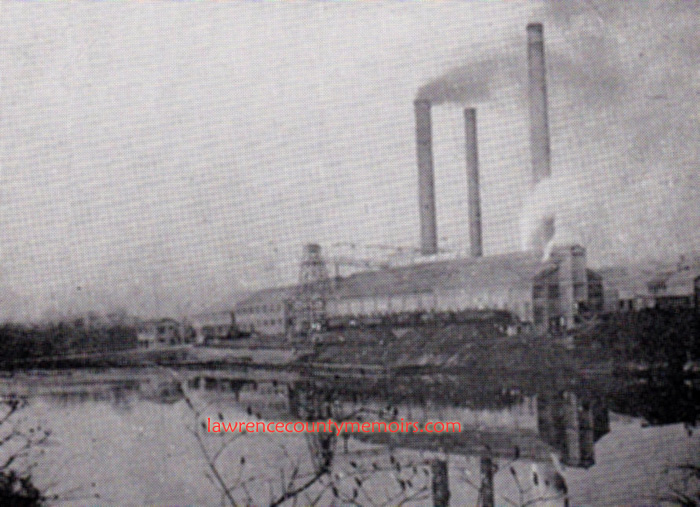 This plant, built and initially operated by the Shinn brothers, opened in 1874 as the Wampum Cement Company. The facility was renowned for its quality product and supplied cement for such projects as Brooklyn Bridge (built between 1870-1883). It was purchased and the Crescent Portland Cement Company in 1901 and almost completely rebuilt. It was renamed as the Medusa Portland Cement Co. (later Medusa Corp.) in 1929. Years later it was purchased by Southdown and then CEMEX. (c1910) Full Size |
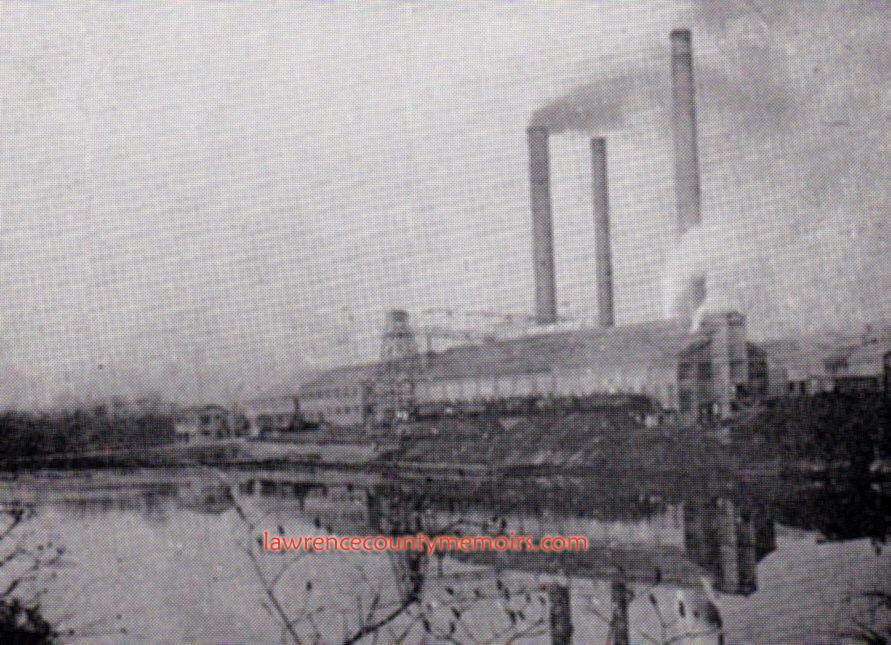
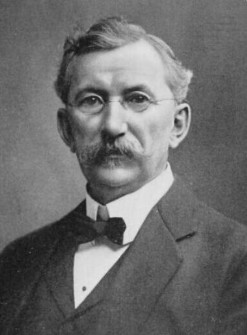 The Wampum Cement works was established by New Jersey-native John Shinn and his two brothers in 1874. (c1885) | 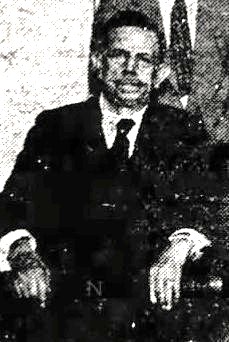 David M. Kirk was elected president of the Crescent Portland Cement Company in 1910 and became a well-known community leader in the area. (1927) |
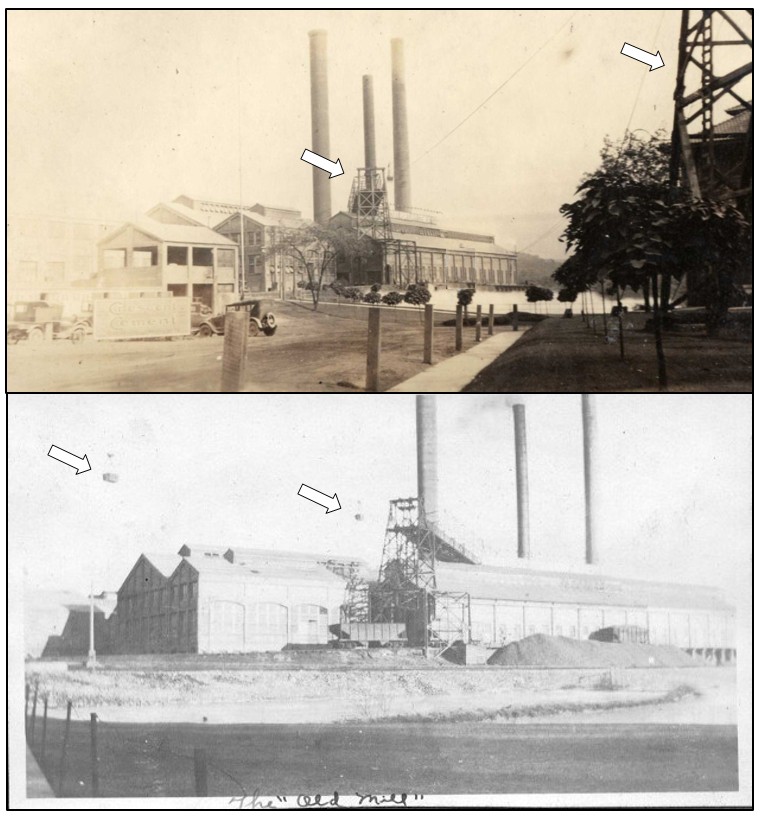 Limestone was mined from the hillside just to the west of the plant. In the early days huge blocks of limestone were carted by men and mules to an aerial “rope railroad,” which used gravity to transport the limestone blocks downhill to the crusher at the plant. The mules were later replaced with narrow-gauge “dinky” railroad cars and steam-powered shovels were also put in operation to help unearth the limestone. In these photos you can see the towers, cables, and buckets of the rope railroad. (Both photos – c1915) |
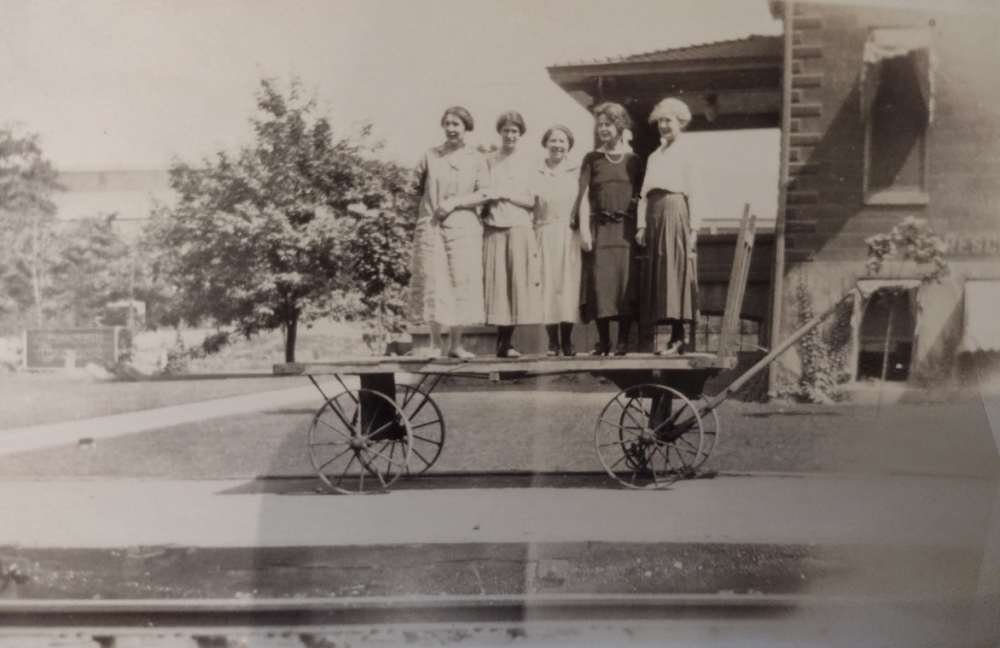 The ladies who worked in the main office of the Wampum plant. (c1920) |
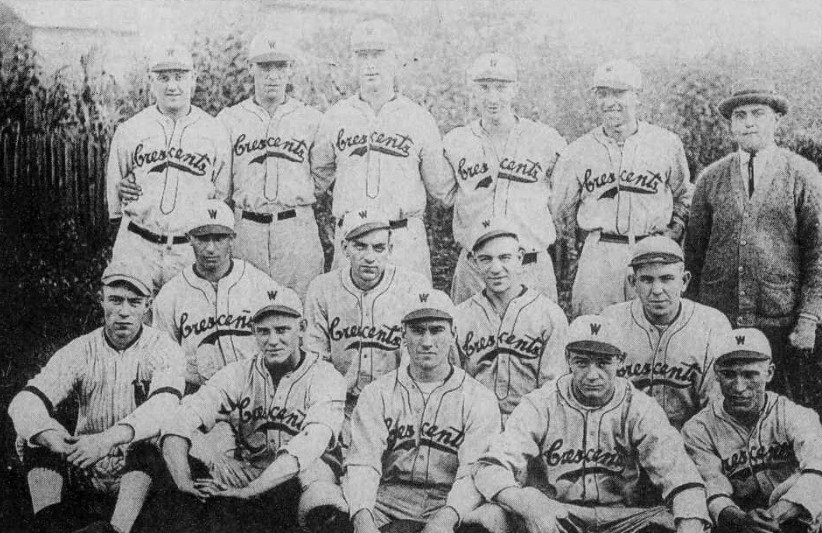 The plant workers organized their first baseball team in 1908 and over the coming years played teams from all around the region. (c1923) |
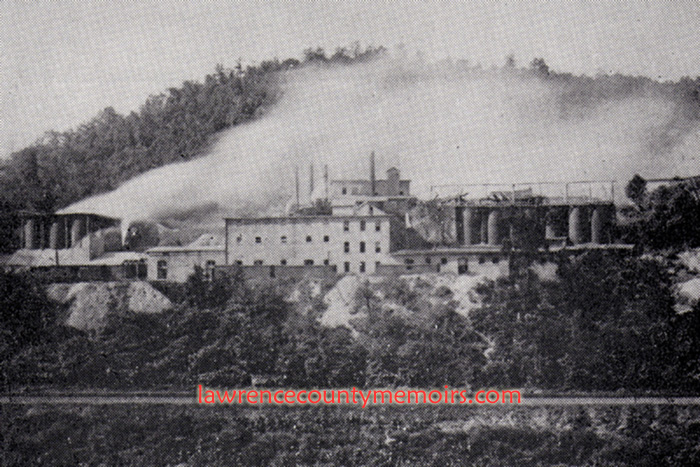 The cement works in Wampum, which opened in 1874, was the oldest, continuously operated Portland cement manufacturing plant in the United States when it was closed in 2010. (c1930) |
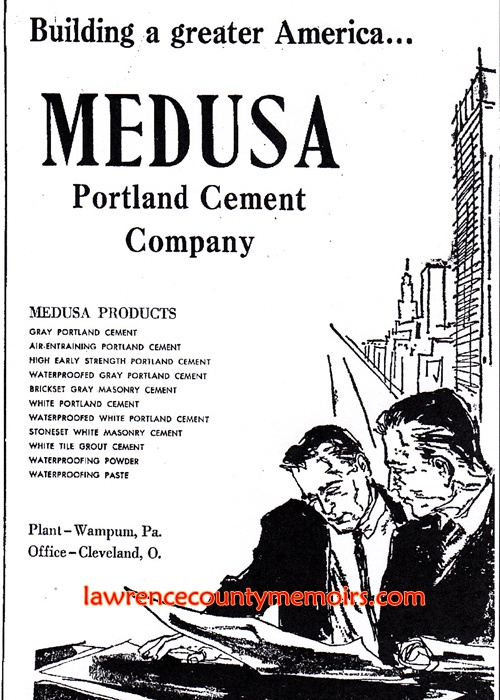 An advertisement for the Medusa Cement Company. (1964) |
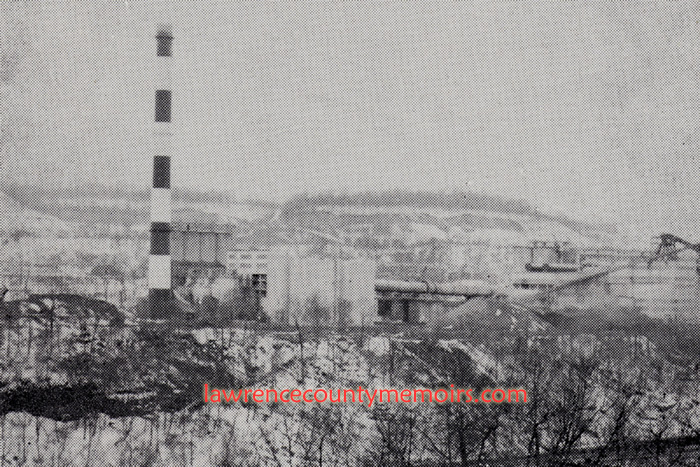 A wintertime view of the Medusa Plant in Wampum. (c1955) |
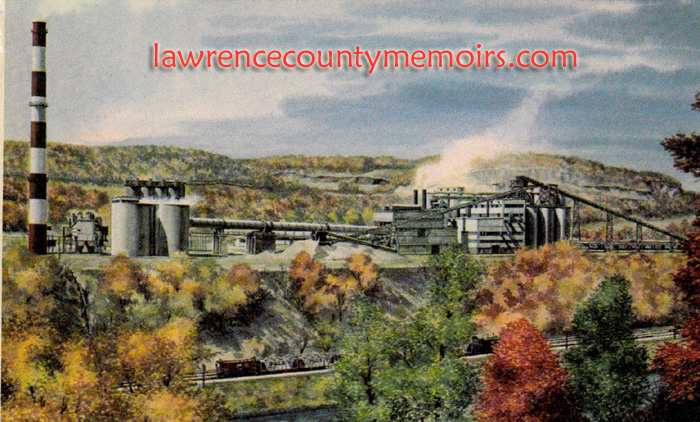 Famous railroading artist Howard Fogg (1917-1996) rendered this painting of a Pittsburgh & Lake Erie Railroad (P&LE) train steaming by the massive cement plant in Wampum sometime in the 1950’s. |
 |
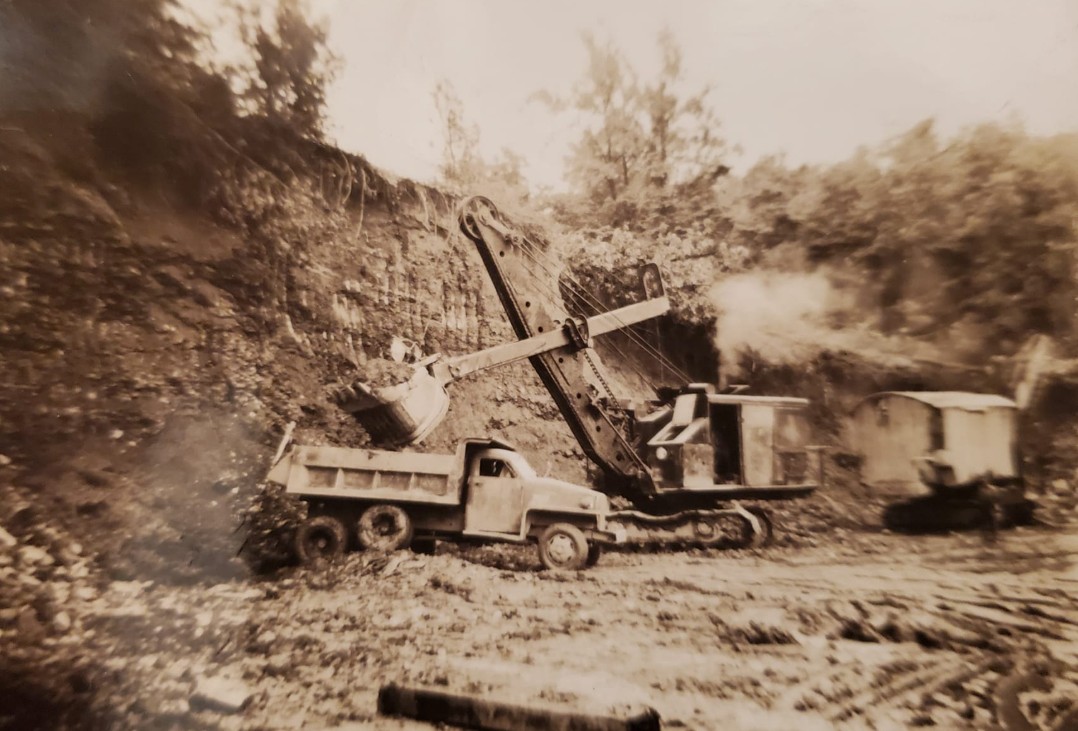 Steam-powered shovels and heavy-duty trucks, shown here at work in Wampum, eventually became the workhorses in the quarries. (c1950) |
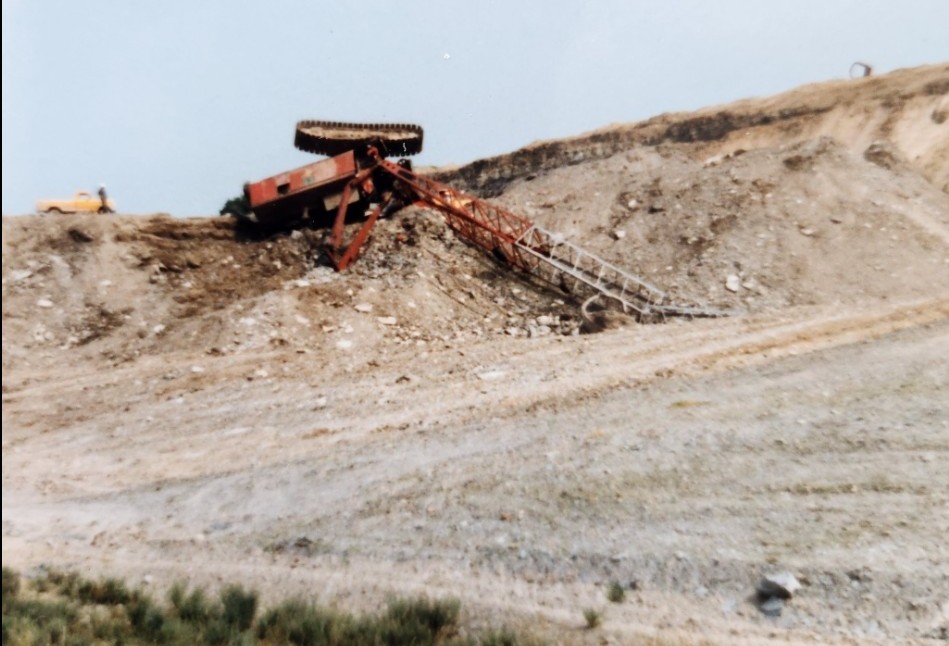 Limestone mining operations, often conducted 24 hours a day, were always dangerous and this Manitowoc 4600 dragline in the Wampum Quarry near West Pittsburg toppled over at 3:30am on Monday, June 24, 1983. Sadly, the operator, 38-year-old Arthur Okeson of Ellwood City, was killed as a result. (1983) |
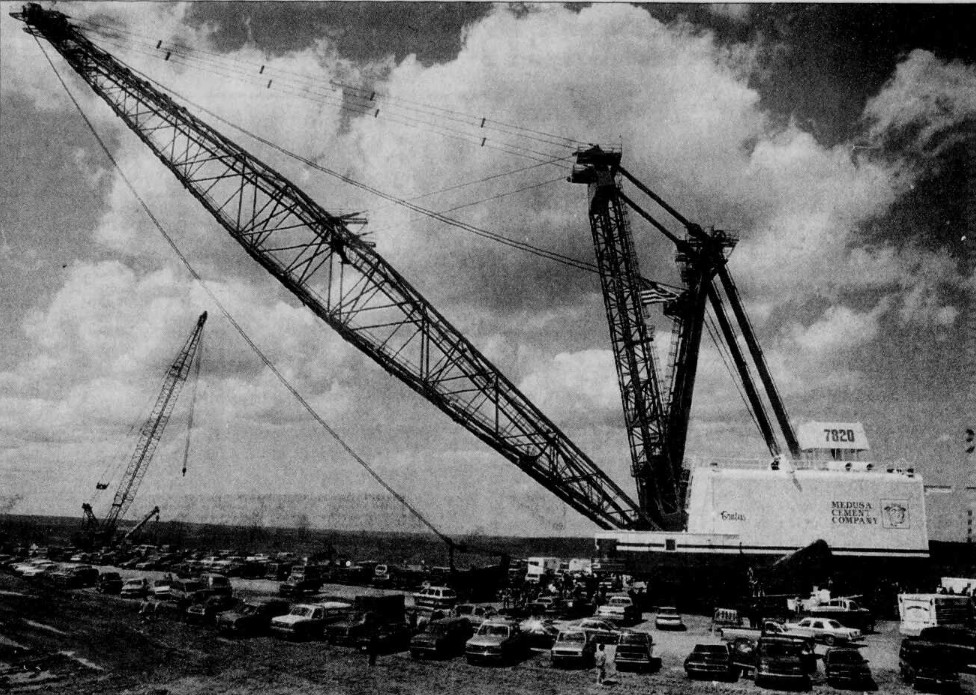 Medusa acquired this massive 2100-ton Marion 7820 walking dragline in 1993 from a coal mining company in McHenry, Kentucky. “Big Blue,” as it was known, was disassembled and shipped to Wampum. It was reassembled on site, by the Industrial Contracting & Erecting Company from Terre Haute, Indiana, in the quarry near West Pittsburg. A public contest resulted in the name “Brutus” being chosen for this beast. Before it went into operation over 4,500 people attended a public open house (shown here) to inspect Brutus in April 1994. (Apr 1994) |
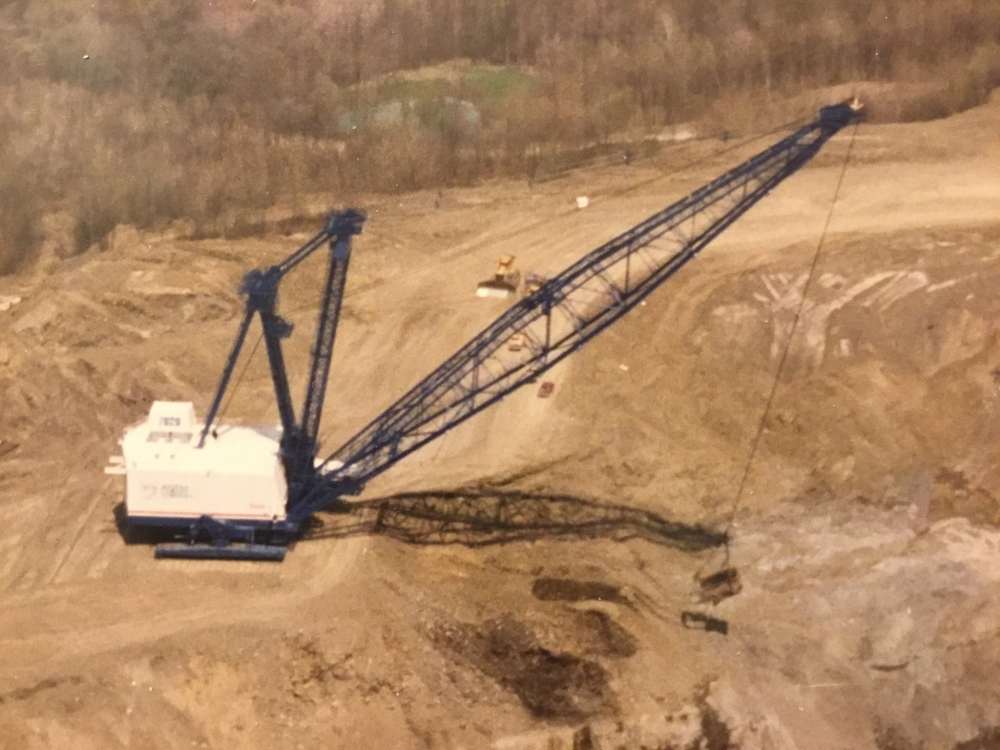 Brutus at work in the Wampum Quarry near West Pittsburg. This “walking dragline” was built with giant footings which could lurch forward to slowly (very slowly) move the structure to where it was needed. Brutus was a huge upgrade to smaller draglines due to the amount of overburden (dirt, rock, and shale) it could quickly strip away to expose the precious limestone deep below. (c1995) (Don Bates photo) |
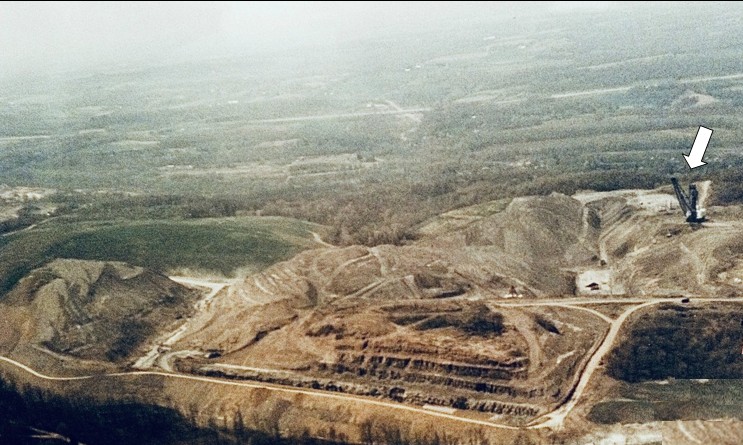 This aerial view shows the sprawling Wampum Quarry with Brutus hard at work (marked by arrow). Just behind the machine is the village of West Pittsburg. The operation of the massive dragline was not performed by Medusa personnel, as the task was contracted out to Minserco Inc. (c1995) (Don Bates photo) |
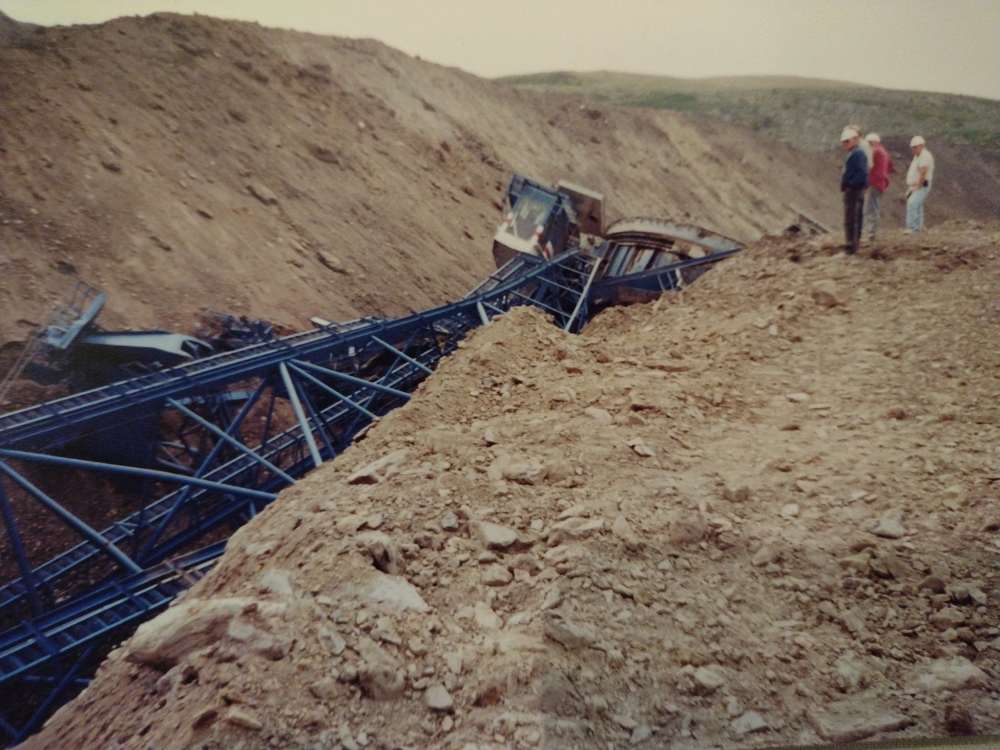 On Friday, September 24, 1999, Brutus (then working for Southdown) fell off the “pad” and toppled upside down into the 70-foot-deep pit below. The dragline suffered extensive damage and two men operating the unit were transported to Jameson Hospital. One of them, David Carcaise of New Castle, was seriously injured and subsequently airlifted to a hospital in Pittsburgh. It was determined that several factors led to the accident, including a lack of proper ballast on the machine. Eventually, Carcaise was awarded over $6 million in damages after a jury trial in 2004. The case was appealed all the way to the Supreme Court of Pennsylvania – but the verdict held. (Sep 1999) (Don Bates photo) |
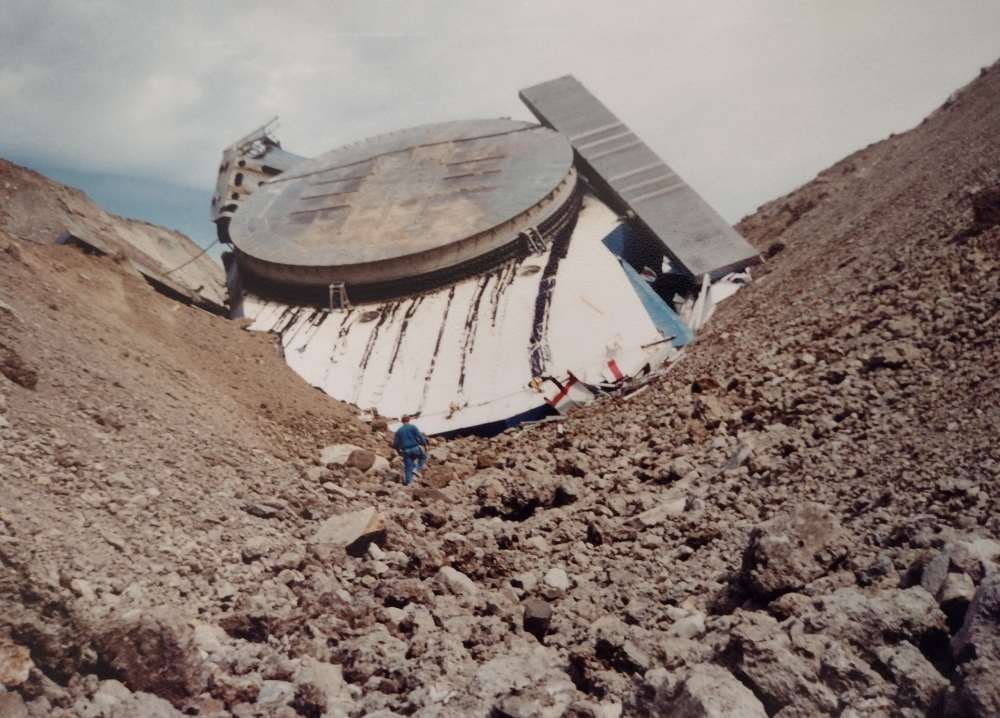 It took a major effort to extract Brutus from the pit, which was finally accomplished in the summer of 2000. The unit was rebuilt by Bucyrus-Erie of Bucyrus, Ohio, and went back in operation (now for CEMEX) as “Lazarus” by early 2001. (Sep 1999) (Don Bates photo) | 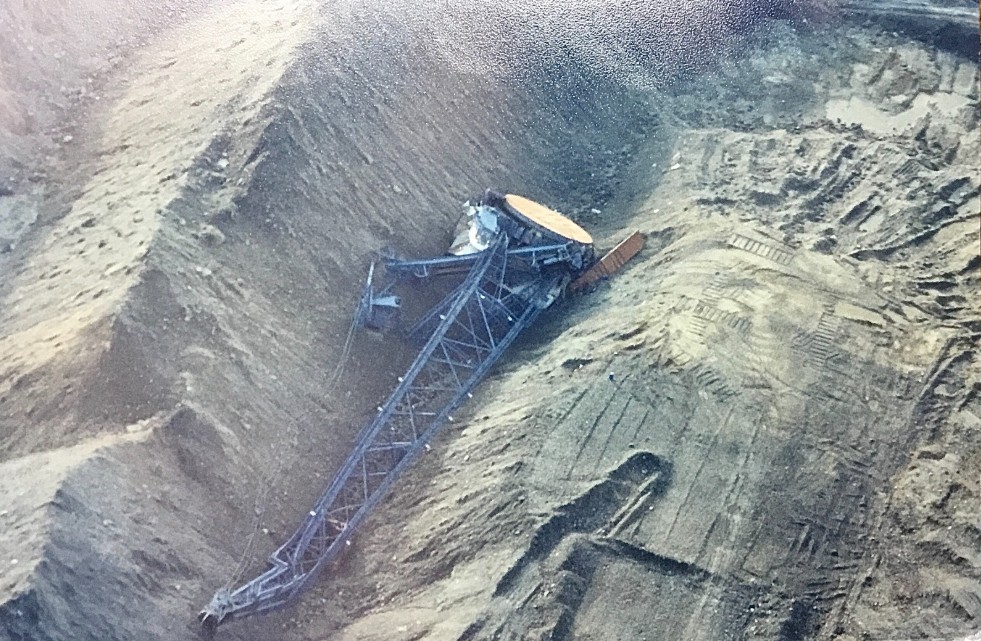 The Marion 7820 was later auctioned off when CEMEX ceased local operations in Wampum in late 2010. It was relocated and put in service at a quarry in Berkeley County, South Carolina. (Sep 1999) (Don Bates photo) (1927) |
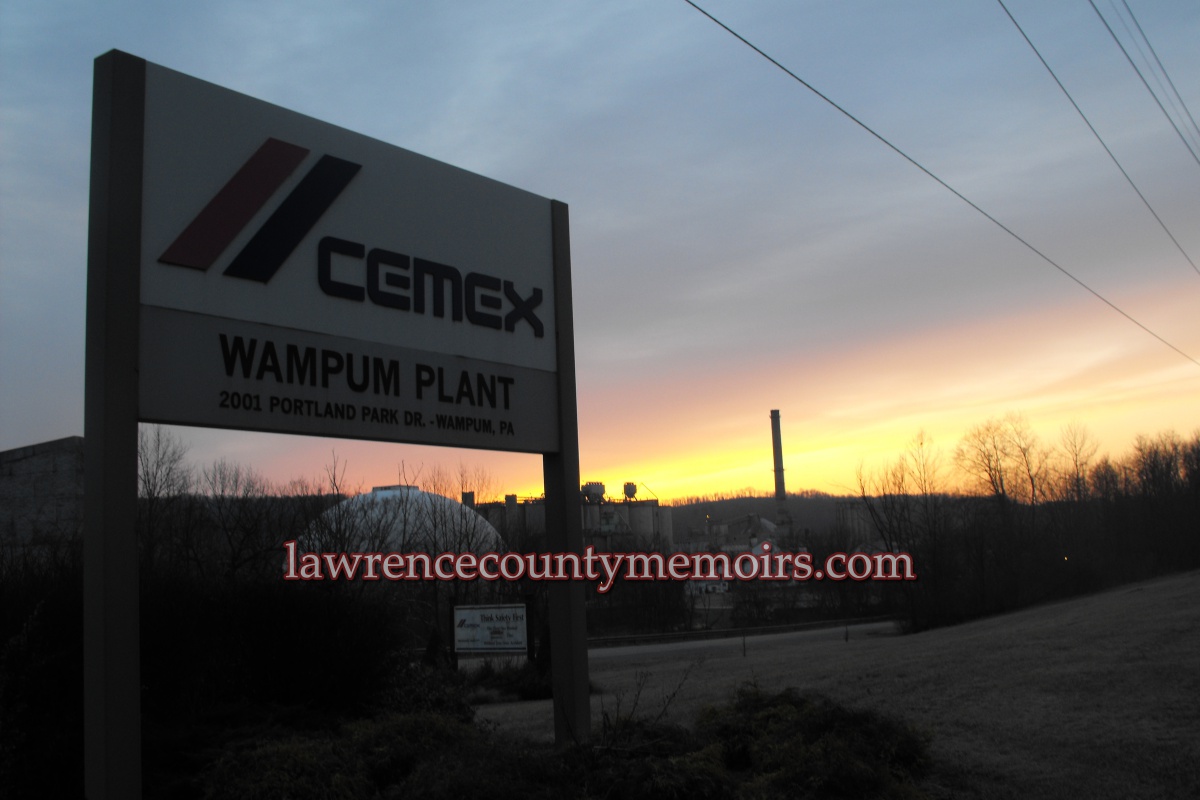 The entrance to the cement plant at dawn. (Mar 2012) |
Comments
Karen #
I was interested in more information on the Medusa Estate that is now the Mines and Meadows resort. I know that there was a mansion on the property and would like more information regarding the history and maybe a picture of the house. If you could include some family history that would be great too. Thank you for your help.
Bryan #
I have a color picture that was taken in 1972
ron blinn jr #
The medusa estate burned down long before I can remember, I’m 33. There was also some sort of camp ground there, also run down. As a young boy we played in these ruins. So much was built and left for time to reclaim, several building’s stood like a very old barn and half of the mansion that wad left standing, I believe there was a fire that destroyed the main house. But I do rember a block foundation in the middle of a pond, we stood in the middle of the pond and fished. Was then used by Indian archery club then everything was destroyed by mines and meadows camping and rv. Ruined a major part of our history
arthur jenne #
How was Arthur Kirk involved in the Cement Plant?
Comment